
Sex Offender Checks in Coos County
The Oregon State Police Sex Offender Registration program is the official state source. It tracks people required to register because they live, work, or attend school in Oregon. Coos County public notice also involves local Community Corrections and law-enforcement channels. Each channel serves a different role.
Start with the state public inquiry for a registry search. Use local notification material to understand a notice in Coos County. For a person who crosses state lines, the national public website can add other jurisdictions. Do not treat any one search as a complete criminal history or a guarantee about risk.
Oregon registration duties apply to a person who resides, works, or attends school in the state. That scope is broader than a home-address list. A Coos County safety check should therefore use the official public disclosure as presented, without assuming that a map pin or city name describes every place tied to the registrant.
Registry Is Not Criminal History
The registry answers a narrow public-safety question. It does not reproduce every arrest, court case, conviction, or supervision event. Oregon State Police CJIS maintains separate criminal-history services, courts maintain case files, and correctional agencies maintain custody data. A registry result should not be stretched beyond the disclosure Oregon law permits.
A qualifying offense may be only one part of a much larger court file. The public registry is organized around registration and notification, while the court docket records charges, motions, judgment, and sentence. Use the registry to support community awareness and the court record to understand the judicial case.
This distinction matters when no public profile appears. Oregon's notification rules vary by risk level and circumstance. Some Level 1 or Level 2 information may be released only in targeted settings. Youth disclosure is narrower. Absence from the public search is not a broad safety clearance and does not establish that a person has no registration duty.
How to Search the Oregon Sex Offender Inquiry System
The public inquiry is terms- and script-gated. Accept its conditions before using the live search. Because the research did not verify the interface's current field labels, radius choices, or buttons, those labels are not guessed here. Follow the fields shown on the official live form and confirm any possible match from the profile.
- Open the OSP program hub and follow its public inquiry link.
- Read and accept the official conditions of use.
- Enter only the name or place details requested by the live form.
- Compare likely results carefully and open the official profile.
- Use Coos County notification contacts if local context is needed.
| Search Stage | Input | Required | Use |
|---|---|---|---|
| Conditions | Acceptance | Yes | Opens the script-gated inquiry. |
| Search form | Live labeled fields | As shown | Use only the fields displayed by OSP. |
| Results | Possible matches | No | Compare identifiers before opening a profile. |
| Profile | Public details | No | Read risk and registration information in context. |
The live form controls the exact search options. If an address, radius, or alert choice is not displayed, do not assume it exists. A careful match uses only the public identifiers OSP provides and returns to the agency when the result is unclear.
Three Coos County Registry Channels
OSP operates the inquiry and statewide program. Coos County Community Corrections can be relevant when a person is also under local supervision, but registration and supervision are not the same. A person can have a registration duty without current probation or post-prison supervision. Police or the sheriff handle urgent local public-safety concerns and possible noncompliance reports.
The OSP Sex Offender Registration program page is shown in this source image.
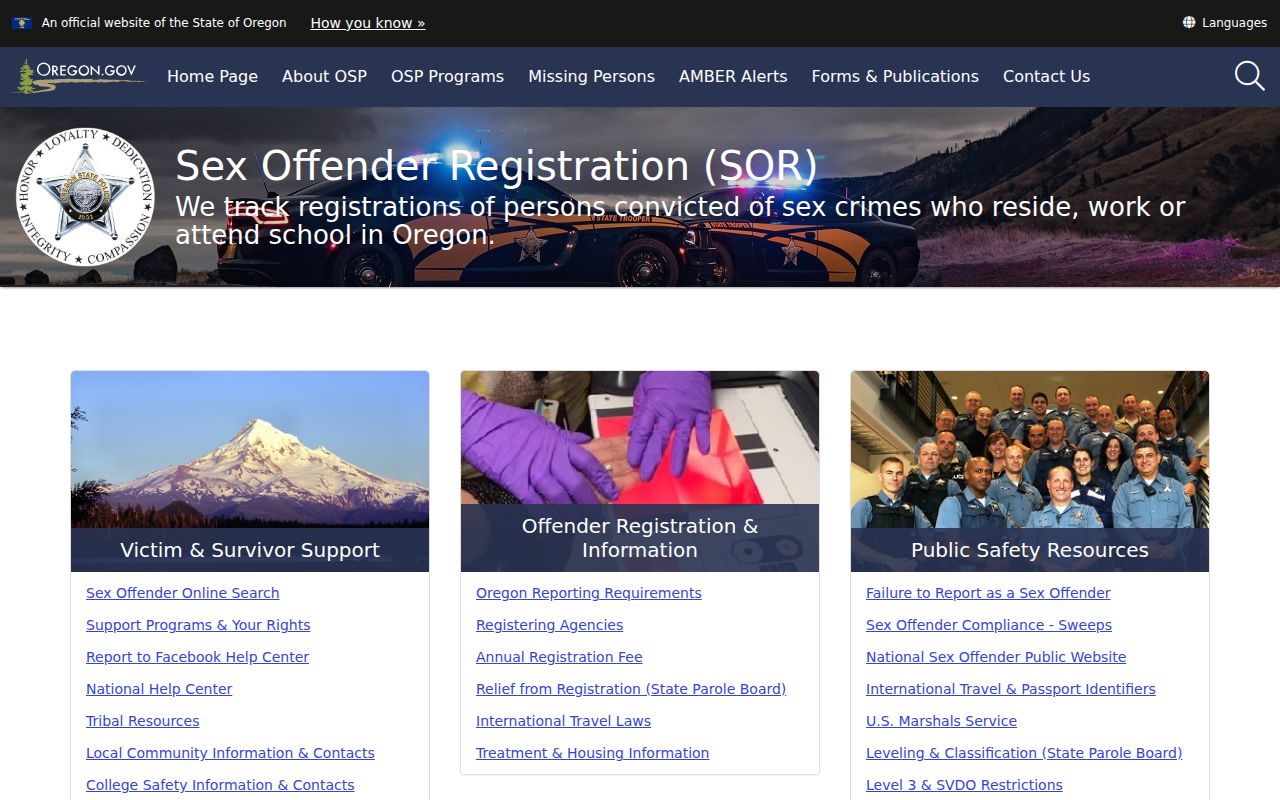
Its program links are the right gateway to current Oregon registry information.
Local supervision information has its own limits. Community Corrections may confirm or route a question about a supervised person, but detailed supervision files can be confidential. Registration does not itself prove current parole, probation, or post-prison supervision. Likewise, the end of supervision does not by itself end a registration duty.
Inside a Registry Profile
Public fields depend on Oregon's disclosure decision and the live system. A profile should be read as the public portion of a specialized registration record. It should not be read as a complete case file, supervision file, or statement that every listed fact remains unchanged.
| Identity | Name and any aliases OSP publicly displays. |
|---|---|
| Photo and Description | Public identifying material shown for matching, when disclosed. |
| Location | The address, city, or area information Oregon law permits. |
| Offense | Public qualifying offense information, not a whole court docket. |
| Risk Level | Oregon's Level 1, 2, or 3 notification classification. |
| Status | Registration details made public through the official system. |
Confirm identity before relying on a profile. Similar names do not establish a match, and a public photo may not resolve every doubt. The court file remains the source for the underlying case and judgment. OSP's registry entry explains the public registration information that Oregon has chosen to disclose.
Coos Registry Visibility Rules
ORS Chapter 163A controls public disclosure. Level 3 information receives broad public notice. Level 1 and Level 2 information can be released in targeted circumstances, and OSP may disclose details it deems needed to protect the public concerning a person or area. Public treatment of juvenile-adjudicated registrants is usually narrower.
The chapter's structure is captured from the official Oregon Legislature source for ORS Chapter 163A.
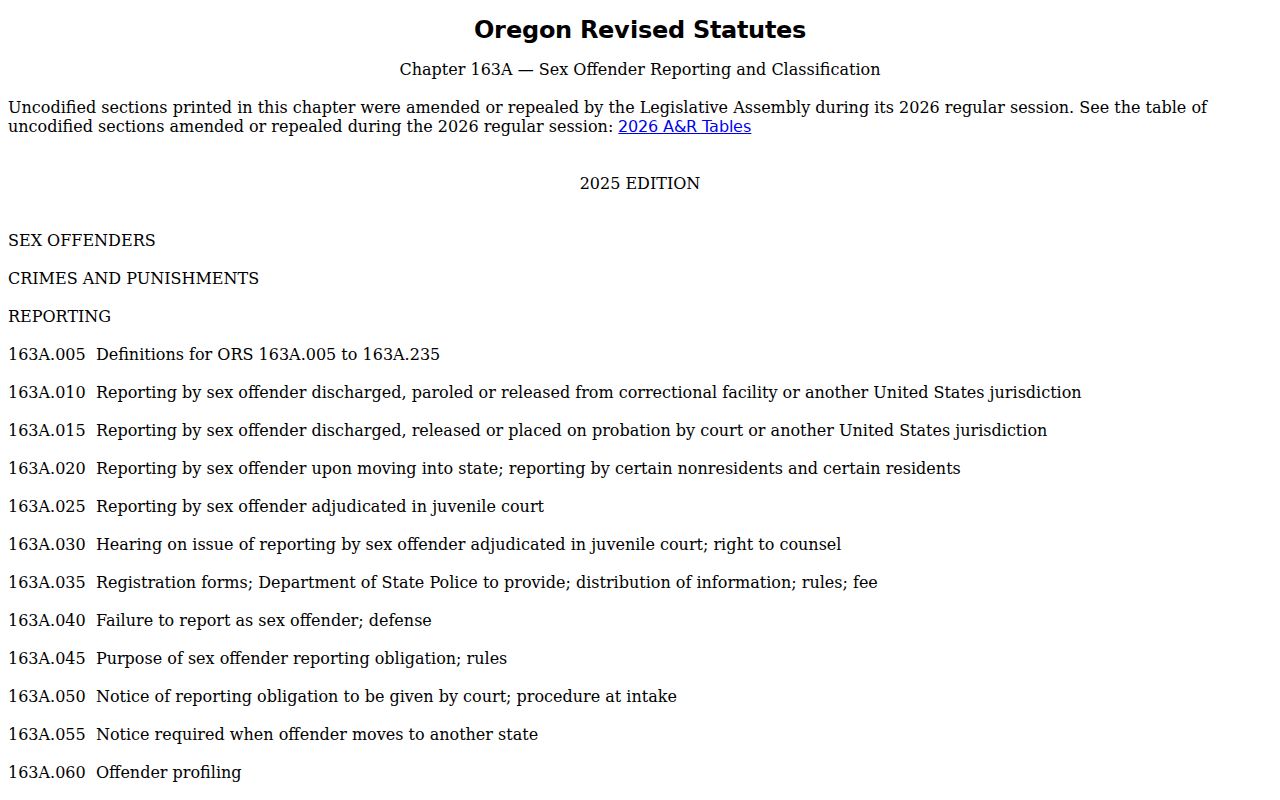
The statute, rather than a federal tier chart, defines the Oregon disclosure and relief framework.
For a person adjudicated in juvenile court, ORS 163A.225 generally narrows information released on request to a name, year of birth, and city or ZIP unless broader conditions apply. OSP also retains authority to disclose information it finds necessary to protect the public concerning a particular offender or geographic area. That makes visibility a legal decision, not a simple count of all people who must register.
Oregon Registration Levels and Requirements
Oregon uses notification risk levels, not federal SORNA tier-duration shorthand. The Board of Parole and Post-Prison Supervision performs most adult classifications with Oregon's risk framework. The Psychiatric Security Review Board handles people under guilty-except-for-insanity jurisdiction. A sexually violent dangerous offender must be Level 3.
| Oregon Level | Risk and Public Notice | Duration |
|---|---|---|
| Level 1 | Lower risk; public disclosure is generally narrower. | Continuing unless a qualifying person obtains statutory relief. |
| Level 2 | Moderate risk; targeted disclosure may apply. | Continuing unless eligible relief or reclassification is granted. |
| Level 3 | Highest risk; broad public notification. | Continuing; statutory bars can limit relief. |
Only a qualifying Level 1 registrant may obtain relief from reporting. A Level 2 or Level 3 registrant may be able to seek reclassification by one level, but bars apply. Some people ever classified Level 3 cannot obtain relief. Oregon duration must not be summarized as a generic ten-year, 25-year, or life chart.
Relief and reclassification are formal statutory outcomes. A change does not occur because a person has lived in Coos County for a certain number of years or finished community supervision. Readers should rely on the current OSP classification and any governing order, rather than calculating an end date from federal tier labels.
How Oregon Assigns Risk Levels
The state's classification material explains the legal and rule framework behind Level 1, Level 2, and Level 3. Risk level affects public notification, but it does not say whether a person is now on probation or post-prison supervision. Those are separate legal statuses with separate custodians.
OSP's official registry statutes and rules page appears in this image.
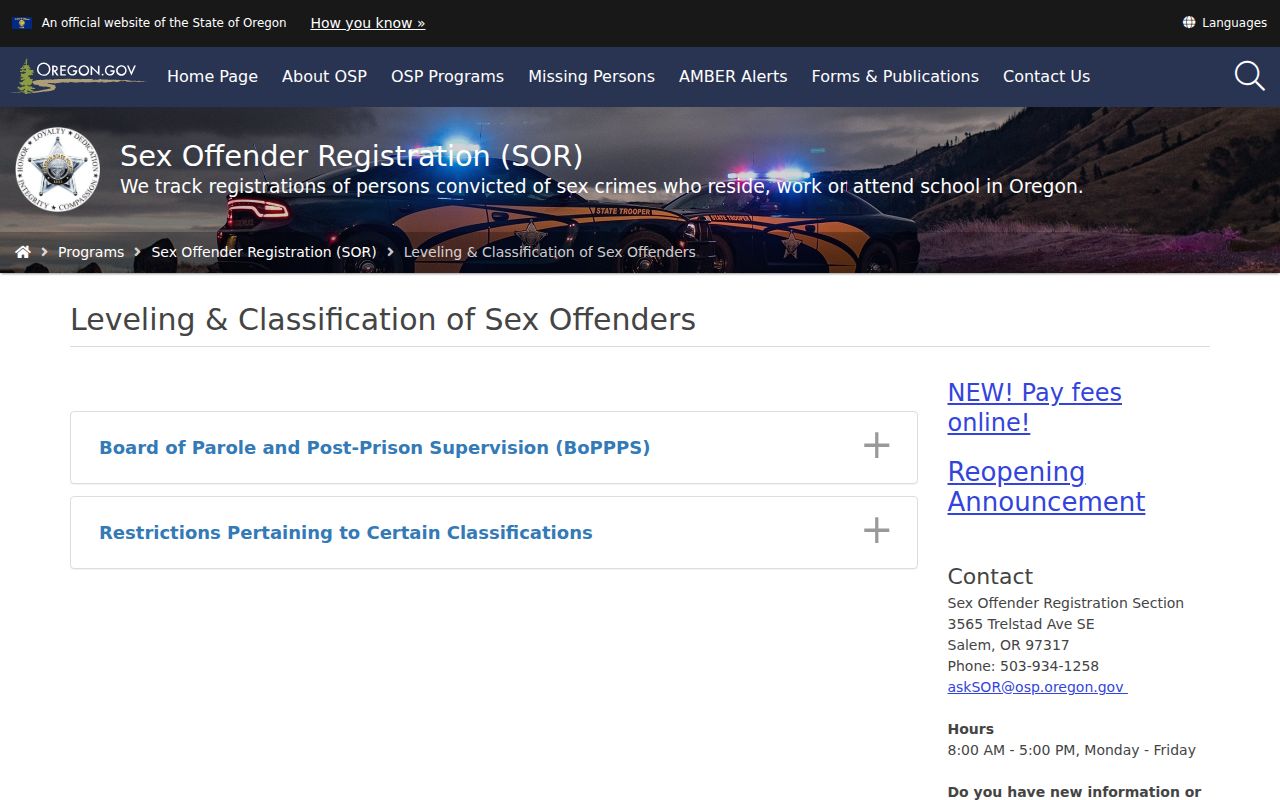
The source helps readers avoid importing federal tier terms that Oregon does not use for its notification levels.
Coos Search and NSOPW
The Dru Sjodin National Sex Offender Public Website is the official nationwide supplement. It can help when a safety question crosses Oregon's border or a person recently moved. It gathers public jurisdiction data, so the underlying state source still governs what is displayed and how current it is.
For a Coos County concern, use OSP first and the national search as a second layer. If conduct creates an immediate threat, contact law enforcement rather than trying to investigate or confront anyone. Registry information supports awareness and sound safety planning. It does not authorize private enforcement.
The national site reflects what participating jurisdictions make public. A difference between its result and Oregon's inquiry can reflect timing or disclosure rules. Return to the OSP source for Oregon details and report a suspected compliance issue through an official local channel.
Community Notification and Lawful Use
Coos County notification can include a neighborhood meeting, door-to-door flyers, newspaper notice, or other targeted methods when officials determine notice is warranted. Registration is the legal duty to report. Community notification is the separate act of giving authorized information to people who may need it. Not every registered person receives the same public notice.
Use registry information lawfully: ORS Chapter 163A and the official conditions govern public use. Harassing, threatening, intimidating, or using registry data for vigilantism can be a crime. Report concerns to the proper agency.
Personal and family safety are the proper focus. Verify a result with the originating office, account for limited disclosure, and never assume a public profile is a complete record of a person's conduct or legal status.
If behavior around a child or another vulnerable person causes concern, record the facts that can be safely observed and contact the proper law-enforcement or supervision office. Do not confront the person, publish private details, or organize private surveillance. Call emergency services when there is an immediate threat.